


Department Lead

Sundary Sormendi Gómez
Contact information
91 196 44 46
transferencia.con@cbm.csic.es
Research excellence is built not only on scientific discoveries, but also on the advanced platforms, models, tools and expertise that make those discoveries possible.
Our research groups have developed and established a wide range of specialized R&D capabilities, including disease models, cellular platforms, animal models, cutting-edge analytical techniques, bioprocess development tools and other enabling technologies that support innovation across the life sciences.
These capabilities are available to academic institutions, biotechnology companies, pharmaceutical partners and other organizations seeking scientific collaboration, technical support or access to unique research resources. Through licensing opportunities, collaborative R&D projects and tailored scientific services, we help accelerate the translation of research into impactful solutions.
Explore our portfolio of R&D capabilities and discover how our expertise can support your innovation goals. For further information, please contact our Knowledge Transfer Unit.
γδ17 T-LTICs cell line for inflammatory and autoimmune diseases studies
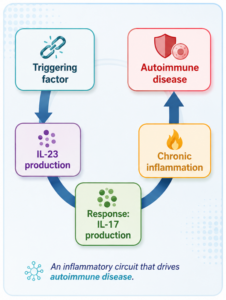 |
Stable cell line derived from murine IL-17–producing γδT lymphocytes (γδ17), designed as an experimental model for the study of type 3 immunity and inflammatory and autoimmune diseases mediated by the IL-23/IL-17 axis. |
Market need
γδ17 lymphocytes and their regulatory role in the IL-23/IL-17 axis are key in several diseases, including psoriasis, psoriatic arthritis, multiple sclerosis, and inflammatory bowel diseases. To date, the study of γδ17 lymphocytes has been limited by the lack of stable cell models that faithfully reproduce the in vivo characteristics of these cells, leading to the use of freshly isolated primary cells, which are scarce and have limited availability for functional assays or drug screening.
The lack of effective and efficient treatments for these diseases highlights the need for new platforms for the screening and development of novel drugs targeting the IL-23/IL-17 axis.
Proposed Solution
The gd17 T-LTICs cell line retains phenotypic and functional properties characteristic of primary γδ17 lymphocytes, including the expression of lineage-associated markers (high CD44 expression, absence of CD27, and expression of RORγt and the IL-23 receptor). In addition, these cells maintain their ability to produce cytokines typical of type 3 immunity, such as IL-17A, IL-17F, IL-22, and GM-CSF.
Notably, these cells respond functionally to stimulation with IL-23 and IL-1β by activating associated intracellular signaling pathways (e.g., phosphorylation of STAT3 and S6), leading to increased production of pro-inflammatory cytokines.
Competitive advantages
- The only stable cell line derived from γδ17 lymphocytes.
- Phenotype and effector functions characteristic of γδ17 lymphocytes are stable over time.
- Robust functional responses to pathophysiological stimuli relevant to several inflammatory and autoimmune diseases.
- Enables reproducible pharmacological screening assays to identify compounds capable of modulating the IL-23/IL-17 axis.